
11Th5
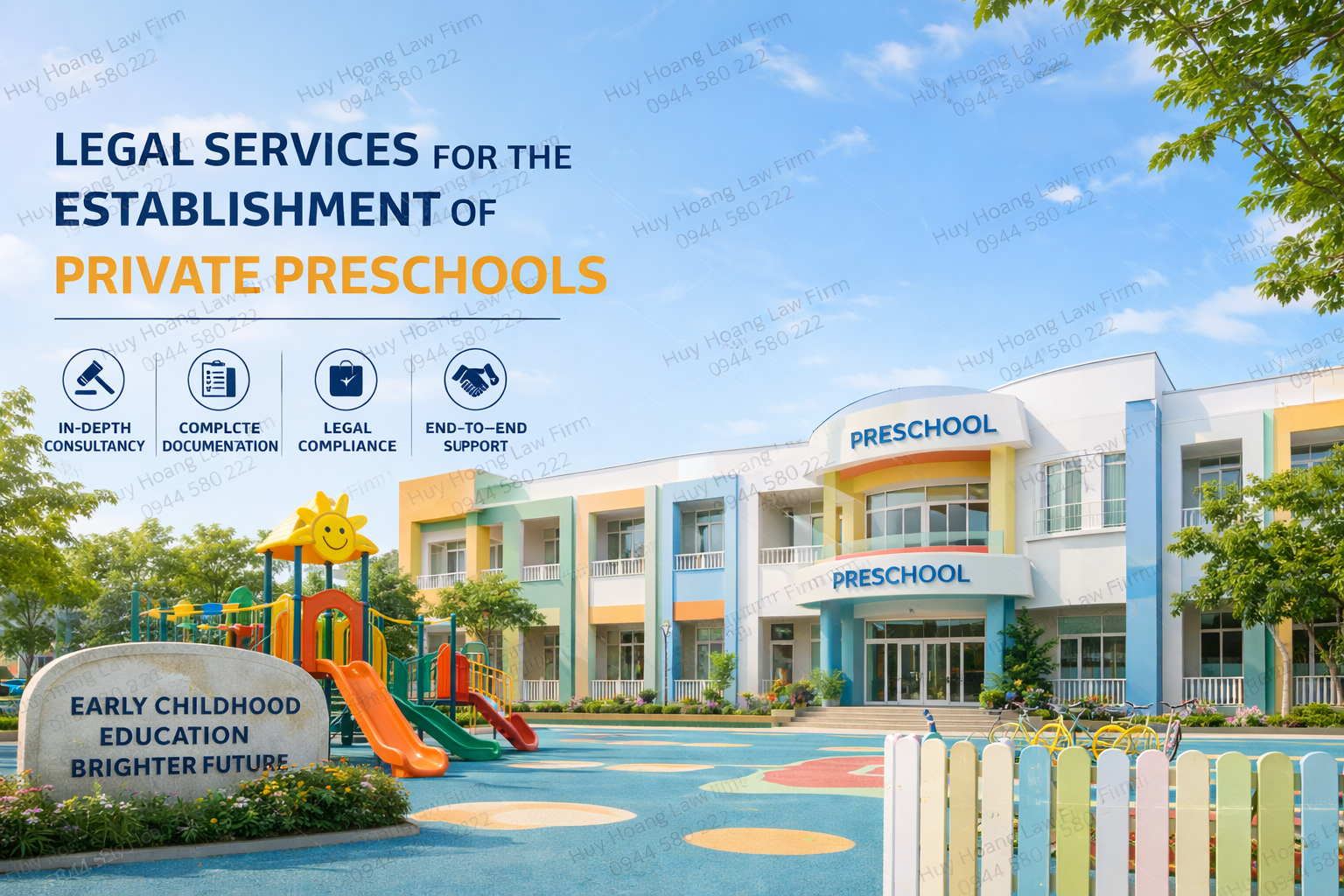
PRIVATE KINDERGARTEN ESTABLISHMENT SERVICE
At present, in addition to public preschools established by the State, the demand for children to attend private kindergartens is increasingly growing due to the diversity of educational programs, modern facilities, and flexible learning environments. Furthermore, together with population growth and the increasing demand for childcare and preschool education services, the establishment of private kindergartens has become an investment trend attracting considerable interest from individuals and organizations.
However, in order to legally establish and operate a private kindergarten, individuals and organizations must fully satisfy the conditions prescribed by law regarding education, facilities, teaching staff, and must comply with the procedures for obtaining the relevant establishment and operation licenses. Therefore, how are the procedures for establishing a private kindergarten carried out?
1. What is a Private Kindergarten?
A private kindergarten is a preschool educational institution established by private individuals or organizations for the purpose of enrolling nursery-age and kindergarten-age children, thereby contributing together with the State to the development of education and meeting social demands. Such institutions may only be established and operated upon approval by competent authorities and must comply with the regulations of the Ministry of Education and Training and relevant laws.
2. Conditions for Establishing a Private Kindergarten
In order to establish a kindergarten, an establishment proposal approved by the competent state authority must first be prepared, clearly identifying the objectives, tasks, educational programs and contents, land area, facilities, equipment, proposed construction location, organizational structure, human resources, financial resources, and other relevant matters.
Minimum Requirements on Facilities and Infrastructure
2.1. Administrative and Management Area
a) Principal’s office: must include a working office equipped with office machinery and equipment in accordance with current regulations;
b) Vice Principal’s office: must be equipped with office machinery and equipment in accordance with current regulations;
c) School office: at least one office room must be provided and equipped with office machinery and equipment in accordance with current regulations;
d) Staff room: at least one room must be provided with lockers for personal belongings;
e) Security room: at least one room must be arranged near the school entrance with a convenient observation position;
f) Restrooms for teachers, officers, and employees: arranged according to functional areas, with separate male and female restrooms. Where separate restroom areas are arranged, they must be conveniently located and must not adversely affect the environment;
g) Parking area for teachers, officers, and employees: must be covered and sufficient for the school’s personnel.
2.2. Childcare, Nurturing, and Educational Facilities
a) Childcare, nurturing, and educational rooms
Each group or class must have one room, including the following functional areas:
– A common activity area for learning, playing, and dining activities;
– A sleeping area (for kindergarten classes, the sleeping area may be combined with the common activity area);
– A restroom area enclosed within the childcare and educational room, with partitions of 1.20 meters between urinals and toilets, including from 02 to 03 wall-mounted urinals for boys (or urinal troughs with a minimum length of 2.0 meters) and from 02 to 03 seated toilets for girls. Separate handwashing areas must be arranged at the standard ratio of 08 children per sink, and sanitary equipment must be installed appropriately for the children’s age groups. Separate restrooms for boys and girls are required for kindergarten children. Where restrooms are separately constructed, they must be connected to the childcare and educational room through corridors to ensure convenient use and easy supervision;
– Covered veranda and child reception area convenient for child pick-up, drop-off, and activities during rainy or sunny weather. Railings surrounding the veranda must be at least 1.0 meter in height.
b) Physical education and arts rooms
Such rooms must be connected to childcare and educational rooms through corridors. Schools with up to 14 groups/classes must have at least one multifunctional room for both physical education and arts education. Schools with more than 14 groups/classes must have at least one arts education room and one physical education room. Satellite campuses with 05 or more groups/classes must have at least one multifunctional room.
c) Separate playground
Outdoor equipment and toys must be installed in accordance with applicable regulations.
2.3. Dining Facilities (Applicable to Schools Organizing Meal Preparation)
a) Kitchen
The kitchen must be independent from other functional areas and include preliminary processing, food preparation, cooking, and food distribution areas; it must be designed and organized according to a one-way operational process.
b) Kitchen storage
Food and ingredient storage areas must be separately arranged, with convenient import/export access and equipment for food preservation.
2.4. Auxiliary Facilities
a) Meeting room
At least one meeting room must be provided for collective activities and professional meetings outside teaching hours and fully equipped in accordance with current regulations.
b) Medical room
At least one medical room must be provided in a convenient location for first aid and emergency treatment, equipped with essential medicines, first-aid tools, and beds.
c) Storage room
At least one storage room must be provided for common equipment and teaching materials.
d) Schoolyard and garden
Including common playgrounds, gardens, and lawns used for outdoor games and performances. The ground surface must be level, non-slippery, and planted with trees providing shade.
e) Gates and fences
The school premises and satellite campuses must be separated from surrounding areas by protective fences or walls to ensure safety and security. School gates must be solid and durable for installation of the school signboard.
2.5. Technical Infrastructure
a) Clean water supply system
The water supply system must satisfy usage demands and comply with current water quality standards. Drainage systems and wastewater treatment systems must ensure wastewater quality before discharge into the environment.
b) Electricity supply system
The electricity system must ensure sufficient capacity and operational safety for school activities.
c) Fire prevention and firefighting system
The fire prevention and firefighting system must comply with current regulations.
d) Information technology and communication infrastructure
Telephone and internet connection systems must be provided to serve school operations.
e) Waste collection area
The waste collection area must be independently arranged, located away from functional areas and downwind, with separate access convenient for waste collection and transportation, and independent drainage systems that do not adversely affect the environment.
2.6. Construction Requirements
The facilities specified above must be constructed in permanent or semi-permanent structures, with permanent structures accounting for at least 40%.
2.7. Teaching Equipment
Teaching equipment must be provided in accordance with regulations issued by the Ministry of Education and Training.
Conditions Regarding Location, Scale, and Land Area
2.8. Requirements on School Location
a) The location must conform to the local educational development planning;
b) The surrounding environment must ensure safety for children, teachers, officers, and employees;
c) Convenient transportation access for child pick-up and drop-off and compliance with fire prevention and firefighting requirements must be ensured.
2.9. Operational Scale
a) A kindergarten must have a minimum scale of 09 groups/classes and a maximum of 20 groups/classes. Schools located in disadvantaged communes must have at least 05 groups/classes;
b) Depending on local conditions, satellite campuses may be established at different locations to facilitate children’s access to school, with no more than 05 campuses, or no more than 08 campuses in disadvantaged communes.
2.10. Land Area
The land area for school construction shall be determined based on the number of groups/classes and children, with a minimum average of 12m² per child. For mountainous urban areas and central urban areas with limited land resources, the minimum average may be reduced to 10m² per child.
2.11. Construction Floor Area Standards
Administrative and management facilities must comply with current regulations;
Facilities for childcare, dining, and auxiliary purposes shall comply with Appendix I attached to the relevant regulations.
2.12. Building Height Requirements
Facilities directly serving childcare, nurturing, and educational activities must not exceed 03 floors and must ensure accessibility for children with disabilities.
3. Procedures for Establishing a Private Kindergarten in Compliance with Law
Required Application Dossier
– Written request for establishment or permission for establishment of the kindergarten (in accordance with Form No. 01, Appendix II issued together with Decree No. 125/2024/ND-CP);
– Proposal for establishment or permission for establishment of the kindergarten (in accordance with Form No. 02, Appendix II issued together with Decree No. 125/2024/ND-CP).
Implementation Procedures
Organizations or individuals (in the case of applications for permission to establish people-founded or private kindergartens) shall submit 01 set of application dossier as prescribed in Clause 2 of this Article via the online public service portal, by postal service, or directly to the commune-level People’s Committee.
Within 05 working days from the date of receipt of the dossier, if the dossier is invalid or incomplete, the commune-level People’s Committee shall issue a written notice specifying the contents requiring amendment or supplementation to the agency, organization, or individual requesting the establishment or permission for establishment of the kindergarten.
Within 20 working days from the date of receipt of a complete and valid dossier, the commune-level People’s Committee shall organize the appraisal of the conditions for establishment or permission for establishment of the kindergarten. If all statutory conditions are satisfied, the Chairman of the commune-level People’s Committee shall issue a decision on establishment or permission for establishment of the kindergarten. In cases where the conditions are not fully satisfied, a written notification clearly stating the reasons shall be sent to the requesting agency, organization, or individual.
The decision on establishment or permission for establishment of the kindergarten (in accordance with Form No. 10, Appendix II issued together with Decree No. 125/2024/ND-CP) shall be publicly announced through mass media channels.
Legal Basis:
Clause 2 Article 4 of Decree No. 125/2024/ND-CP dated October 05, 2024 regulating investment and operational conditions in the field of education (as amended and supplemented by Article 4 of Decree No. 142/2025/ND-CP).
Huy Hoang Law Firm
📞 Telephone: +84 944 580 222
📧 Email: tuvan@luathuyhoang.vn
🌐 Website: https://luathuyhoang.vn/
🏢 Address: 2nd Floor, Lot 5, Block 54, Alley 85 Ha Dinh, Khuong Dinh Ward, Hanoi, Hanoi, Vietnam


