
03Th6
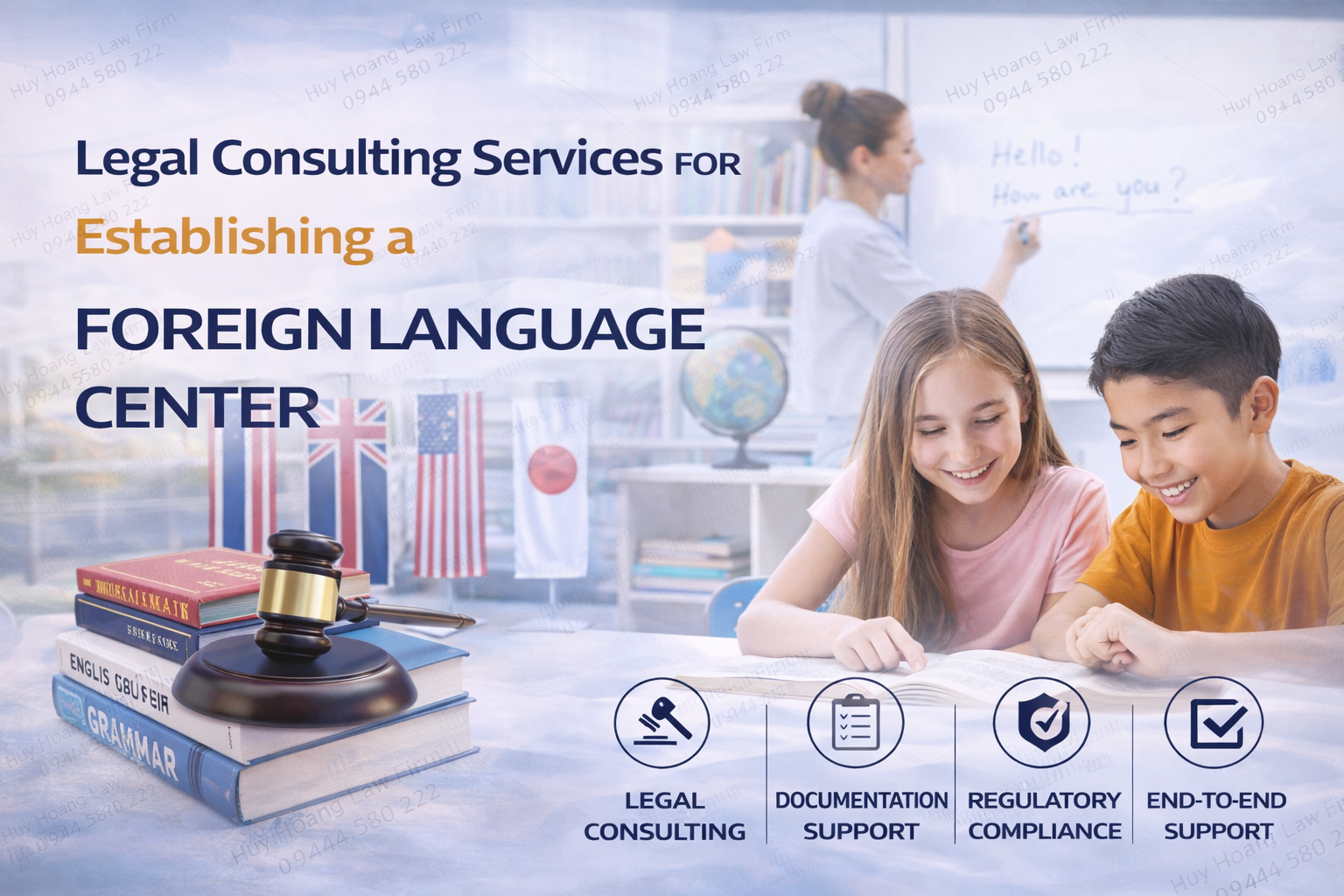
LEGAL CONSULTING SERVICES FOR ESTABLISHING A FOREIGN LANGUAGE CENTER
In the current era of industrialization, modernization, and global integration, foreign language proficiency is deemed an indispensable prerequisite and a key communicative tool bridging diverse cultures globally. The necessity of language acquisition is increasingly vital, serving both academic pursuits and professional applications. To accommodate this growing demand, a multitude of foreign language centers have been founded to provide training and improve linguistic competence. Accordingly, what is the process to establish a foreign language center? What statutory conditions and administrative procedures govern such establishments? Huy Hoang Law Firm clarifies these matters in the following article.
1. DEFINITION OF A FOREIGN LANGUAGE CENTER
A foreign language center is a continuing education institution within the national educational system, which includes:
Public foreign language and informatics centers: Financed and established by the State, ensuring operating conditions as prescribed by law, possessing a legal entity status, its own seal, and separate bank accounts.
Private foreign language and informatics centers: Invested and established by domestic organizations or individuals, ensuring operating conditions as prescribed by law, possessing a legal entity status, its own seal, and separate bank accounts.
Foreign-invested foreign language and informatics centers: Financed wholly or partially by foreign individuals or economic organizations, ensuring operating conditions as prescribed by law, and permitted to use their own seal and separate bank accounts.
(Article 2, Circular No. 21/2018/TT-BGDĐT)
2. CONDITIONS FOR THE ESTABLISHMENT OF A FOREIGN LANGUAGE CENTER
2.1. Personnel Requirements
The organizational structure of a foreign language center consists of: The Director, Deputy Director(s) (if any), specialized/professional departments, advisory councils (if any), Party organization (if any), and mass organizations.
Requirements for the Center Director:
The Director directly manages and operates the organizational structure and apparatus, holding legal liability before the law and superior management authorities for all operations of the center. The Director is appointed by the competent authority that establishes the center. The authority competent to permit the establishment of the center shall issue the decision to recognize the Director (for private and foreign-invested centers). The term of office for the Director is 05 years.
The Director must satisfy the following criteria:
- Graduate with a university degree in foreign languages, or possess a university degree along with a foreign language certificate at least at Level 3 according to the 6-level Foreign Language Proficiency Framework for Vietnam or its equivalent.
- Have a clean personal record/good background.
- Possess management capacity.
- Have at least 03 years of working experience in the field of education and training.
Requirements for the Teaching Staff:
Teachers at the center perform teaching and practical guidance duties, including internal (full-time) teachers, contract (part-time) teachers, Vietnamese teachers, native speakers, and foreign teachers.
- Teacher-to-Student Ratio: The number of teachers depends on the scale of the center’s operations, provided that the average ratio does not exceed 25 students per teacher per session.
- Vietnamese Teachers: Must possess at least an associate degree (college degree) in foreign language pedagogy, or an associate degree in foreign languages combined with a pedagogical practice certificate.
- Native Teachers (for specific languages): Must possess at least an associate degree and a relevant foreign language teaching certificate.
- Foreign Teachers: Eligible to teach when meeting one of the following standards:
- An associate degree in foreign language pedagogy or higher;
- An associate degree in foreign languages or higher combined with a relevant foreign language teaching certificate;
- An associate degree or higher, a language proficiency certificate at Level 5 or higher according to the 6-level Foreign Language Proficiency Framework for Vietnam (or equivalent), and a relevant foreign language teaching certificate.
2.2. Facility Requirements
Possess a lawful training location backed by a valid lease agreement or land/property use right documents.
Have adequate and appropriate classrooms and functional rooms that meet the requirements of the training program, alongside administrative offices to serve management and training operations.
Classrooms must be well-lit, with a minimum area ensuring 1.5m2 per student per session.
Equit the location with necessary teaching and learning equipment, including desks, chairs, blackboards/whiteboards, projectors, computers, printers, and televisions distributed across classrooms and offices.
Fully satisfy Fire Prevention and Fighting (FPF) regulations, including required equipment such as FPF instruction charts, fire extinguishers, etc.
2.3. Curriculum Requirements
The center may utilize curricula issued by the Ministry of Education and Training, or self-compile/select educational materials from universities, colleges, or domestic and international educational organizations that match the learners’ demands and the center’s capacity.
The Director shall be legally liable before the law and educational management agencies for the content of the curriculum and teaching materials. Simultaneously, the Director is responsible for reporting the utilized programs and materials to the university president/college principal (for centers under higher education institutions) or the Director of the Department of Education and Training (for other local centers).
3. AUTHORITY TO ESTABLISH AND PERMIT EDUCATIONAL OPERATIONS
3.1. Competence to Establish a Foreign Language Center
Pursuant to Article 47 of Consolidated Document No. 07/VBHN-BGDĐT (2018), the establishment depends on the respective component authority:
- The Chairman of the Provincial People’s Committee or the Director of the Department of Education and Training (if authorized by the Chairman): Decides on subordinate centers, centers under intermediate schools, and centers proposed by organizations or individuals.
- Directors of Universities/Academies, Presidents of Universities, or Principals of Colleges: Decide on their respective subordinate centers.
- Heads of social organizations, socio-professional organizations, or economic organizations permitted by law to establish subordinate training units hold the competence to decide on their own subordinate centers.
3.2. Competence to Permit Educational Operations
The Director of the Department of Education and Training permits educational operations for subordinate centers, centers under intermediate schools, centers proposed by organizations/individuals, centers under universities/colleges located outside the main campus, and centers under ministries, departments, social, or socio-professional organizations headquartered in the locality.
Directors of Universities/Academies, Presidents of Universities, or Principals of Colleges permit educational operations for centers operating within their institutional campuses.
4. ADMINISTRATIVE PROCEDURES FOR THE ESTABLISHMENT AND OPERATION
The process is divided into two major phases:
Phase 1: Application for the Establishment License
Required Dossier:
- A formal submission/proposal requesting the establishment of the center.
- An establishment scheme/project detailing: the center’s name, location, necessity, legal basis, objectives, duties, teaching curriculum, training scale, facilities, organizational structure, and the curriculum vitae (CV) of the prospective Director.
- A draft of the internal rules and regulations governing the center’s operations.
Implementation Process:
- Submission: The applicant submits 01 set of dossiers directly or via post to the competent authority outlined in Section 3.1.
- Appraisal: Within 10 working days from receiving a valid dossier, the competent authority appraises and inspects the establishment conditions.
- Licensing: Within 05 working days following the appraisal, the authorized person issues the Decision on Establishment. If rejected, a written notification stating the explicit reasons must be sent to the applicant.
Phase 2: Application for the Educational Operation License
Required Dossier:
- A formal submission requesting the licensing of educational operations.
- A certified copy of the Decision on Establishment (accompanied by the original for verification).
- The internal educational regulations of the center.
- A comprehensive report on facilities, equipment, curricula, teaching materials, management staff, and teachers; documentation proving the lawful right to use the land/building, and the financial resources securing the center’s operations.
- A lease contract for the property along with its legal land/house ownership certificates.
- A Fire Prevention and Fighting inspection record or validation minutes.
- A written commitment regarding security and order, certified by the local Commune/Ward People’s Committee.
Implementation Process:
- Submission: Upon receiving the establishment license, the center submits 01 set of operational dossiers directly or via post to the competent licensing authority outlined in Section 3.2.
- Dossier Review: Within 05 working days of receipt, the receiving authority reviews the dossier. If any amendments or supplements are required, a written notice will be issued.
- On-site Inspection: Within 10 working days from receiving a compliant dossier, the receiving authority coordinates with relevant agencies to conduct an on-site evaluation of the center’s actual capacity and records the findings in an appraisal report.
- Issuance of Operation License: Within 05 working days from the inspection date, the authority issues the decision permitting educational operations. In case of refusal, a written notice specifying the reasons must be delivered to the center.
5. FULL-PACKAGE CONSULTING SERVICES BY HUY HOANG LAW FIRM
Huy Hoang Law Firm provides comprehensive, end-to-end legal support to streamline your foreign language center setup:
- Pre-evaluation & Strategy: Assessing eligibility conditions beforehand and orienting clients on the optimal structure (e.g., incorporating a company first versus opening the center directly).
- Dossier Drafting: Preparing all required documents up to the standards of the Department of Education and Training (including curricula, training schedules, fee structures, etc.).
- Administrative Representation: Actively representing clients in working and resolving procedures with competent state authorities.
- Liaison & Inspection Support: Managing relations with state authorities and accompanying the enterprise to welcome the on-site inspection team.
- Result Delivery: Securing final licenses and handing over complete legal results directly to the enterprise.
Contact Information:
Huy Hoang Law Firm
📞 Telephone: +84 944 580 222
📧 Email: tuvan@luathuyhoang.vn
🌐 Website: https://luathuyhoang.vn/
🏢 Address: 2nd Floor, LK05 – Urban Area 54, Alley 85 Ha Dinh Street,
Thanh Xuan Trung Ward, Thanh Xuan District, Hanoi, Vietnam


